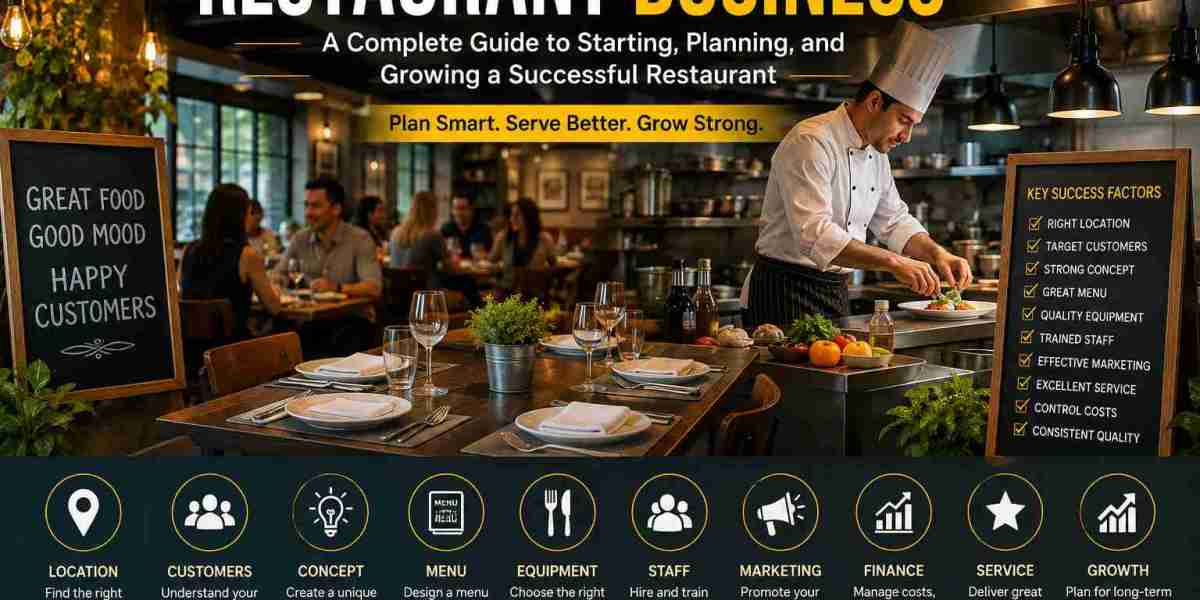

Starting or improving a restaurant business involves much more than creating a menu and opening the doors. Owners need to evaluate demand, location, competition, operating costs, staffing, equipment, customer experience, and the ability to scale. A strong restaurant business is built around decisions that work together rather than isolated choices.
Owners should also document assumptions about opening capacity, average check, customer frequency, and the timeline for reaching stable operations. These assumptions provide useful benchmarks for management reviews.
For restaurant operators evaluating the broader market and site decision, see restaurant business for additional research and planning guidance.
Start With a Clear Restaurant Concept
A clear concept gives the restaurant business a practical identity. Define the cuisine, service model, target customer, average ticket, opening hours, and experience you want to deliver. A fast-casual concept may prioritize throughput and visibility, while a full-service restaurant may need more dining space, parking, and a stronger evening trade.
Choose a Location Based on Evidence
Location can influence visibility, access, rent, delivery economics, labor availability, and repeat visits. Instead of choosing a site because it feels busy, examine traffic patterns, nearby businesses, residential density, competitors, parking, access, and the customer profile. A site that looks attractive at lunchtime may behave very differently at dinner or on weekends.
The practical lesson is to compare evidence with the restaurant's operating model. A decision that looks strong on one metric can become weaker when customer behavior, costs, access, staffing, and competition are considered together.
Build a Realistic Financial Model
Estimate startup costs, rent, deposits, construction, equipment, licenses, technology, payroll, food costs, insurance, marketing, and working capital. Then model realistic sales by daypart. A restaurant business should be able to survive slower periods, not only the best-case opening scenario.
Plan Operations Before Opening
Create systems for purchasing, receiving, storage, prep, cooking, cleaning, inventory counts, waste control, cash handling, and customer service. Standard operating procedures make performance more consistent and reduce dependence on individual employees.
The practical lesson is to compare evidence with the restaurant's operating model. A decision that looks strong on one metric can become weaker when customer behavior, costs, access, staffing, and competition are considered together.
Use Data to Improve Decisions
Restaurant operators can use data to identify profitable dayparts, menu performance, customer patterns, labor needs, and opportunities for improvement. Location and market data are especially useful before signing a lease, while operational data becomes more important after launch.
Create a Customer Experience That Encourages Return Visits
Great food is only one part of the experience. Speed, cleanliness, staff communication, order accuracy, atmosphere, convenience, and consistency all influence whether a customer returns. Build feedback into the operating routine and use it to improve measurable problems.
The practical lesson is to compare evidence with the restaurant's operating model. A decision that looks strong on one metric can become weaker when customer behavior, costs, access, staffing, and competition are considered together.
A useful way to keep the research connected to the restaurant decision is to review restaurant business alongside financial and operational assumptions.
For restaurant-focused location and planning resources, explore RestaurantSiteFinder as part of the research process.
Conclusion
A successful restaurant business is the result of disciplined planning and continuous improvement. Start with a clear concept, validate the market, choose the site carefully, build realistic financial assumptions, and create repeatable operating systems. With the right data and a willingness to adjust, owners can reduce avoidable risk and build a restaurant designed for sustainable growth.
Before making a final decision, revisit restaurant business and compare the guidance with your restaurant's specific market and operating conditions